

Last week's Guest Speaker 211015: Steve Hallam
Posted by Franz Huber
on Oct 25, 2015
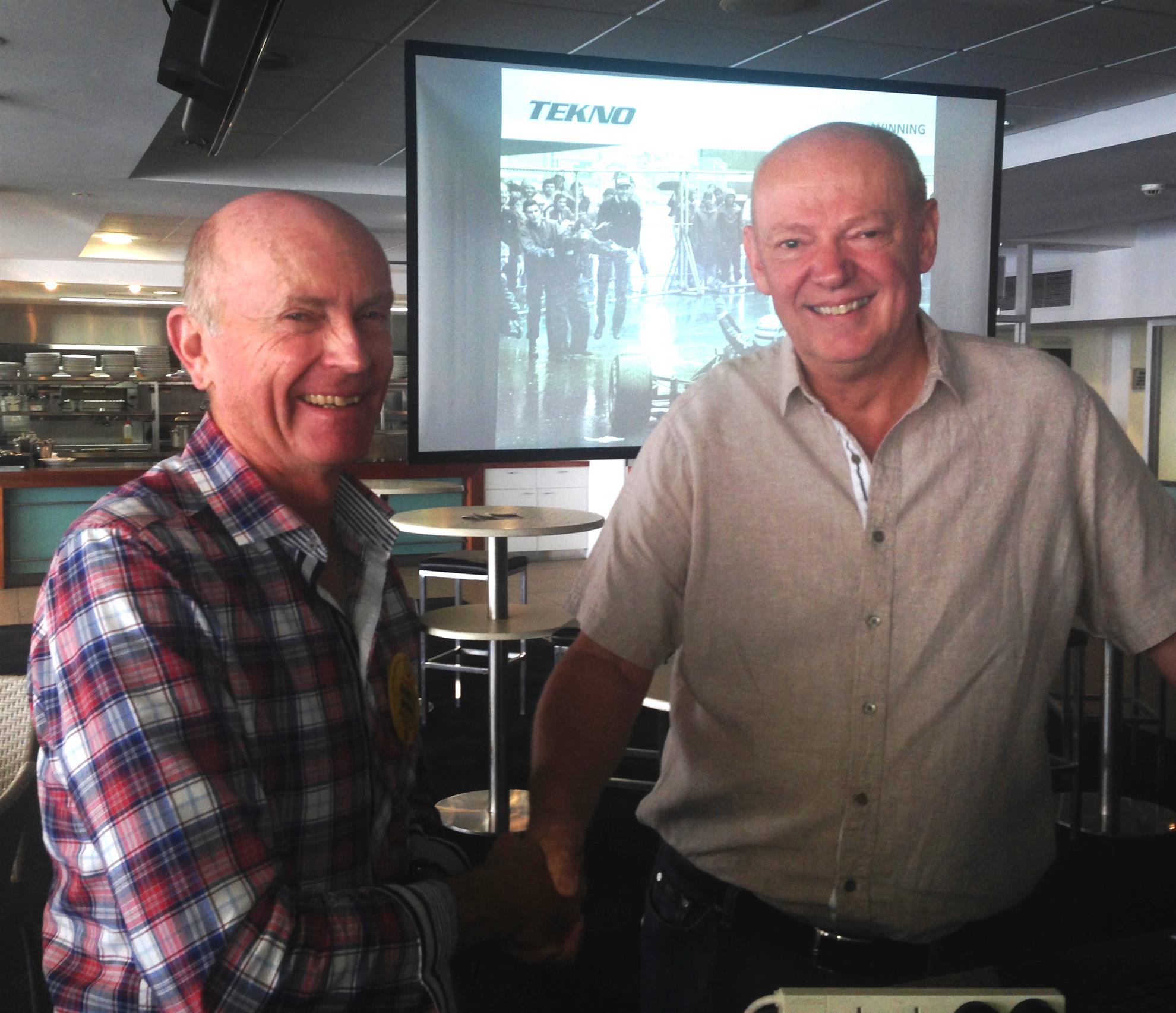 I can't help the feeling that, without some gentle persuasion by our resident Clerk of the Course Ian Mayberry, we may not have got anywhere near to hear this man speak. The archetypal engineer, Steve would have to be the quietest man in the (car racing engineering) background. Linked-in reveals nothing. The company's website www.Tekno.com.au talks about cars, drivers, history... The only entry one can find on the big world wide web is an obscure mention in the Tekno company's Facebook page, going back some 18 months to February 2014.
 Considering that Steve (above right, with DGN Darrell Brown) has been immersed in high-octane fumes for the past 34 years, he appears to be in remarkably good health! His career encompasses some 27 years in Formula 1 racing, where he worked with some 10 teams and 4 manufacturers. He was Ayrton Senna's race engineer at John Player Lotus in the early 80's, then moved on to McLaren where, as Head of Race Engineering for some 20 years, he again worked with Ayrton Senna. He was heavily involved with Ayrton's three World Driver Championships and later on Mika Hakkinen's two championship trophies. He worked with David Coulthard and "The Iceman" Kimi Raikkonen.
From an ignorant TV spectactor's (such as your Editor's) point of view, Formula 1 consists of ridiculously powerful cars being driven by men with cooling fluid rather than blood in their veins. So, when Steve stated that they are running on a 1.6 litre engine... What?? 1.6 litres?!? But that is where the similarity to a Hyundai Getz or a Holden Barina ends.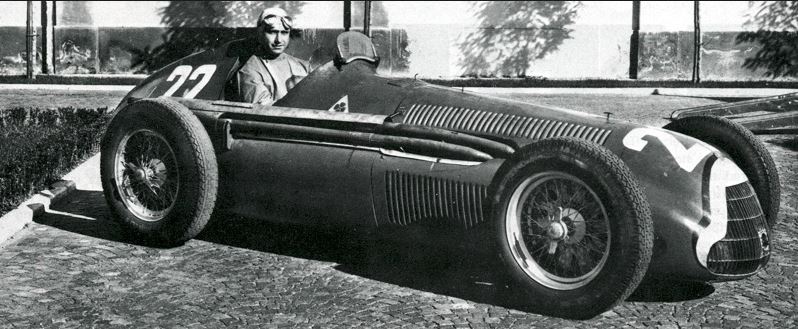
Steve took us on a journey through the early days of F1 racing, from the first race in May 1950, when the Alpha 159 (see picture on right) was the hot car. Italy totally dominated the scene. The evolution process brought us to the 1959 Cooper - Jack Brabham was driving one of them - with the engine at the rear. 1977 saw the first car with wings, the Lotus Type 78. It had an underbody which generated airflow under the car, sort of sucking it to the ground. 1982 saw a major change in materials: Fibre...
Today's cars are taking advantage of just about anything that saves weight, that saves power (electricity generation instead of braking, harnessing energy from heat). They weigh just 700 Kg. [A Holden Commodore weighs more than double that. But then it is designed to carry up to 5 people who, if they conform to average statistics, are somewhat overweight... ;-)]
How many people does it take to put a driver on the track? [No, nothing to do with lightbulbs!] Well, a team has approximately 650 personnel. Plus the engine manufacturer has about 500 people in their team.
Still, at man needs to have a change of scenery sometimes. So Steve switched to Nascars (US based super charged V8's). "There is nothing on the road like them" Steve enthused: They have 40 races every year. The V8 engine develops some 800 Horsepower at 10,000 RPM. The rules constantly change to clip back performance - every season". And it costs about $US 25 Million to run a team.
But ultimately Steve found his new niche with the V8 Supercars in Australia. "Only" 15 events per year, but multiple races in each event. And on the weekend's Gold Coast 600, Steve's team won the first race and came 5th in the second one on Sunday! Congratulations!